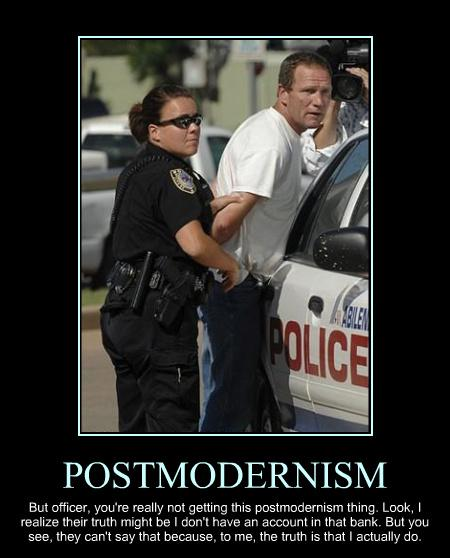
Saturday, 22 June 2013

Conclusion:

As you may have already realized, I myself am a Christian, and my worldview has been subsequently altered by this fact. I do however not consider my Christianity as simply a way of viewing my world - having a  personal relationship with Jesus Christ doesn't just define my view of the world, it defines my whole life and every aspect of it. Not just how I see others around me, but how I treat them. Christianity is not simply a set of rules, a test of good deeds that will grant you Salvation. No. Christianity is a lifestyle, which means that it is constant and ongoing and improving and growing stronger.

Christianity is not a noun my friends; it is a verb. 

Having a personal relationship with my Savior totally transforms the way I treat other people. And I take no credit for this. It is simply the love of God, the amazing and unconditional love of God, which I chose to accept - working through me. Imagine blessing the next door neighbor who keeps stealing from your award winning lemon tree - or choosing not to gossip that really annoying colleague at work (who no one likes because she just doesn't know how to stop talking!). Imagine choosing to forgive your boss for making you work that double shift, instead of moaning about him behind his back. Imagine loving your enemies and actually not only doing good things to those people who put you through sucky situations,  but doing good things with a loving and caring heart. 

I know what you're thinking. What.ever. That is impossible. But that is the power that the love of God has. If you chose it. Now I'm not saying you'll be perfect forever and ever amen. No way! The Bible talks about the   "renewing of your mind" and that you will be "transformed" by this renewing process. I am still learning and changing everyday, and will continue to grow in the Lord for the rest of my life. Choosing Christ is not choosing to say "I'm perfect" or "I'm better than you", it's choosing to accept that yeah, ya screwed up big time at this thing called life and you need someone to help you through it - someone who loves you unconditionally. 

This assignment has taught me so much about the world around me. And I hope that you don't assume, that  by sharing my personal beliefs about Christianity, I am saying that I think Postmodernism and every other religion and worldview for that matter, is totally and utterly ridiculous. Absolutely not. I hold the highest respect for anyone who chooses to live their whole life for something - whether I personally think it is 'right' or not. I simply find it sad that those who have a Postmodern worldview are missing out on so much in their lives. From personal experience with my own life, and the lives of my friends and family members, focusing on one's self and finding one's own personal 'truth'  (whatever that may be) so often leads people to be cynical and unhappy. I guess once you have experienced that incredible love, you just want everyone else to experience it too. 

Now this isn't a conversion blog. I'm not expecting any of you to suddenly fall on your knees and have some kind of spiritual event that causes you to turn your life around. I simply ask that you think about your life, and think about what your worldview really is - and why. This assignment has challenged me to do just that, and I can tell you that it is so refreshing, satisfying and encouraging to remind yourself why you believe what you do. This may be a turning point for you, a point at which you actually look at your beliefs and realize you don't know exactly what it is that you do believe. Some of you may be ok with that, and that is absolutely cool. Others of you may start to explore and be challenged to broaden your beliefs or may even question the very essence of your worldview. Heck, some of you might even change your worldview altogether!
I simply ask that you ponder about what you have read (or most likely skimmed through) in this blog. And I pray that you will eventually find joy and meaning in your life and come to know how precious and irreplaceable you are. I know some of you may cringe to hear it, some of you may be silently crying out for it, and some of you may be repelled by the very thought of it - but I'll end this blog by saying that you are loved by God, no matter what you've done and no matter what kind of person you are today, or have been in the past. And it is my prayer that the knowledge that someone out there loves you, will never leave you mind.

 "Therefore, if anyone is in Christ, he is a new creation. The old has passed away; behold, the new has come." 
2 Corinthians 5:17 


In this next section I will be discussing two SIMILARITIES between Postmodernism and Christianity

1. One Similarity between these two worldviews is the importance each worldview places on growth. I have talked a lot about the Postmodernist view on change and discussed in lengths the Christian view of its dependence on an unchanging and steadfast God; BUT, and yes there is a but, there is in fact a similarity here:

Christians believe in the importance of Spiritual growth, as they en-devour to become more 'Christ-like' and less like their sinful selves. Likewise, Postmodernists highly esteem the act of adapting to ones environment, and changing or growing as the environment changes. While the Christian world view offers a slightly, shall we say more stable option - as the growth or change of one's self  is motivated by an unchanging and perfect role model - The Postmodernist view of constant adaption is still of the same accord. While Postmodernism errs heavily on the side of self discovery and continual worldly transformation affected by worldly changes, the idea of constant growth is very similar to the Christian view. Christianity focuses more on the improvement, becoming less obsessed with self and more focused on others and Christ, instead of simply encouraging change of any kind (like Postmodernism), but improvement and growth is still considered change. They both also highly esteem the practice of meeting in groups to discuss and further their ideas about life and how they should grow - the difference is that Christians call this the body of Christ (His church) and have traditions that do not change (while they may slightly differ from congregation to congregation and denomination to denomination - they do not update these rituals or change them in any way) Postmodernism encourages a 'church-like- group or gathering to be constantly altered and adapted to the time and feelings of the group and also to the environment. But both still to believe in the main principles of these two aspects, namely: fellowship and growth.

2. The Second similarity that these two world views share is malleability or ability to adapt. Christianity does not apply to a specific group of people who have been especially chosen, or who are better than anyone else. No. A murderer, a thief, a loving father, a devoted wife, a single mother, a depressed teenage girl, a school drop-out, a president! Everyone is viewed as equal in the eyes of God, though Christians themselves might judge, God sees everyone as equal - and equally in need of His great love, mercy and forgiveness. Postmodernism views everyone also equally, though some individual Postmodernists may judge (that is obviously a result of their personal morals), the worldview in itself does not encourage inequality and holds equality in high regard. Christianity as mentioned above is malleable - it applies to everyone and anyone willing to accept it - as does Postmodernism. In fact Postmodernism is centered around its very malleability and ability to adapt - Christianity and its principals cannot themselves be changed, but the availability is open to everyone. There is no set mold you have to fit before you can consider Christianity - it is applicable to you right now. In fact it is relevant to everyone, and it is for everyone - every unique person on this entire earth.
The Fourth Difference Continued: (A Postmodern view that many paths lead to the truth and that all religions offer an acceptable avenue to a potential persons 'god' or version of god vs. the Christian view that there is only one God and one way to Him)

Christian View:
The Christian view is simply this: One God, One way. 


"To the King of ages, immortal, invisible, the only God, be honor and glory forever and ever. Amen." 1 Timothy 1:17


Christianity is about one Savior and having a personal relationship with Him. Often referred to as "our heavenly Father", God is described in the Bible as loving and caring - our protector and our comforter. This father figure is said to have died on the cross for us, so that we may get a second chance and one day, live forever in 'paradise' with God. The Bible never refers to any other way of attaining salvation - in fact, unlike any other religion in the world, Christianity offers Salvation as a gift. It is not something that is to be earned or deserved or as a reward for good deeds and sacrifices. No. It is simply a gift from a loving Father who can save you, forgive you and redeem you. Christianity teaches that you are so loved by God, even though you sin over and over again. In fact, even though we blatantly sin and some even openly mock God, according to the Christian worldview, He still loves us! And according to the Bible, His love is so great that our sin to Him is 'as far as the East is from the West'; when our sins are forgiven, they are forgotten. 
Such a close relationship to a God who is so powerful and worthy of awe. I don't know of any other religion or world view that can offer such an astounding free gift. There is only One true God in the Christian faith - and the only way to Him, is through Jesus Christ - accepting that gift of Salvation and accepting that awesome love. 

"But God shows his love for us in that while we were still sinners, Christ died for us" Romans 5:8


Friday, 21 June 2013


The Fourth difference I will be discussing is the Postmodern view that many paths lead to the truth and that all religions offer an acceptable avenue to a potential persons god or version of god and the Christian view that there is only one God and one way to Him

Postmodern View:

From a Postmodern worldview, spiritual pluralism is valid. In fact, since discrimination of anything is discouraged, I suppose it makes sense that they view all religions as of equal importance. It means that Postmodernism provides an umbrella like effect, shielding all views under one 'umbrella' in the midst of a stormy world. To say that you accept someone believes in Buddhism and that another believes in Scientology and that they can both agree to disagree and live their lives - that I can understand. But to say that both are right? And that both their paths lead to truth? Isn't the very essence of a religion based on the fact that people believe the only way to truth is through  one certain religion? Isn't religion saying that my way is right, so your way cannot also be right? So therefore, how can all religions be considered not only right, but complementary of each other. That is what the Postmodernism 'umbrella' offers (though I'm pretty sure the Sciontologist and the Buddhist would prefer to stand in the rain!) Postmodernists are open to everything - it is actually quite a big aspect of their worldview. They esteem the practice of relating in a group and moving forward with fluidity by combining all cultures and religions on our combined, yet very very individual search, to find truth (personally I don't know if I would guarantee any fluidity..but you never know!) 

Maybe there is some truth to the idea that we are all really just chasing the same idea - but I wonder whether giving validity to every single way of attaining that truth is very wise - or even possible

I leave these questions to be pondered as I dash to the grocery store - what a shame that it's raining and I've no umbrella! 


The Third Difference Continued: Postmodern view of pleasing ones self and other versus Christian view of pleasing God

Let me start this with a verse from the Bible in the book of Galatians, 
"Am I now trying to win the approval of human beings, or of God? Or am I trying to please people?If I were still trying to please people, I would not be a servant of Christ..." 
Galatians 1:10
Christianity may be partially about serving others. But that does not mean that we are to bow to the opinions of others or spend our lives trying to please our peers and our ever changing and somewhat corrupted culture. Christianity is about positive growth not just change. Therefore if we are to truly positively improve, the only way to do this is through a pure, loving and never changing savior, according to the Christian world view. To a Christian, putting your faith in others means disappointment and a personal development of skepticism, criticism and a decline in trust of anything good. One of their main principles is this: Others will let you down - Christ will always hold you up. We are not perfect, we make mistakes, we do let people down, and we cannot help that - it's just who we are as imperfect human beings. Christians fully acknowledge that we change, and make mistakes, and that we will disappoint, but that if we put our hope in Christ he will never disappoint. He will never make mistakes, and He will never change. Christians put emphasis on trusting in an eternal and unchanging God, learning from others and seeking wisdom from others past experiences to potentially improve our own life journey. I guess putting your trust in God brings to light another important aspect of Christianity - Hope. When you put your trust in something that is unchanging, ever forgiving "abounding in grace and abounding in love" you can dare to hope. Hope in a better future, hope in a forgiven past. It may sound a bit airy fairy and unpractical, but it is amazing how hope can actually change someones life. Jesus Christ offers this hope. Actually it is hope that partially defines the faith that Christians have, " Now faith is the assurance of things hoped for, the conviction of things not seen." Hebrews 11:1 "For in this hope we were saved. Now hope that is seen is not hope. For who hopes for what he sees? But if we hope for what we do not see, we wait for it with patience." Romans 8:24-25


You see Christianity is not about pleasing God to keep Him happy. God does not need our commitment and faith to keep Him happy - He is there for us. We need Him - Christianity teaches that if you give your life to God and serve Him instead of other people or even just yourself - God will make something beautiful out of your life. You will have something precious; you will have hope.


"For I know the plans I have for you, declares the Lord, plans for welfare and not for evil, to give you a future and a hope" Jeremiah 29:11 
The Third difference I will be discussing is the Postmodern view on the importance of pleasing others and ones self versus the Christian view that our highest en-devour should be to please God, no ourselves, and not everyone around us

Postmodern View:

After making sure that above all else you are happy (after all..life is about what you want..and about your personal quest) the happiness of others comes second. Now don't misunderstand me, I don't mean the happiness of others as a result of self-sacrifice and a servant like attitude to give of yourself so others may benefit. No. I am eluding to pleasing other people for your own gain, or to become 'wrapped' up in the attempt at pleasing everyone so that everyone will like you. Unfortunately, putting your effort into pleasing others does not always pay off... 

to please
As human beings we are constantly changing. We are changing our ideas about the world, changing our feelings towards an individual, changing our minds about having coco puffs instead of wheat-bran in the morning. We grow, we develop, and we expand our thinking through learning. We make mistakes, sometimes we chose to learn from those mistakes - other times, we find ourselves making that same mistake over and over again. My point is that we are not constant in our nature, both mentally and biologically. Therefore trying to spend your life pleasing others whether for your own gain or not, is near to an impossible task. And it is likely that you will end up going crazy. Postmodernism encourages individuals to seek group council and to 'feel' together on a certain issue in the journey of self-discovery. Now don't misunderstand me..I did not say that Postmodernism encourages people to listen to advice and take wisdom from others who may have been through similar circumstances. Don't be crazy! That would make no sense to Postmodernists at all! Other people's personal experiences are not relevant to you - they're not part of your quest.  Postmodernism, as mentioned in  previous posts is all about constantly hitting the 'refresh' button on your life, "...continual inner adaptation to cultural transformation" (Ministries)  It's about focusing on changing mortal beings instead of one divine being somewhere 'up on a cloud'. Focusing on others from this perspective does not mean learning and growing in the sense of trying to improve ones self. No, but by keeping fixed on something that is forever changing (seems like a bit of an oxymoron doesn't it!) one will never cease to keep developing and changing which it is an essential part of the quest for your own personal truth - change is essential. 

Authors musing:
If you personally feel (and God forbid I question your motives since all morals are personal and subject to change themselves) that you should become a pop star because it will help you find who you truly are (until that version of you potentially changes..then you start your quest again!)  you will no likely waste any time trying to thrive in a competitive and cut-throat industry - trying to please your harshest critics who seem to be finding more faults in you, than you had even thought  you had yourself! Of course that is just one example - but living your life trying to be someones version of perfect, or living your life just for yourself - doesn't seem very fulfilling to me. But hey, putting effort into pleasing others is a noble pursuit, and if that is your en-devour in life, then I wholeheartedly wish you all the best! You're going to need it.

Thursday, 20 June 2013


The Second Difference Continued (The difference between the Postmodern belief of rejection of authority and the Christian belief in, and respect of authority)

Christian View:

I think most people with a secular or differing religious worldview, whether they know anything about the Christian faith  or not, all agree on one aspect about Christianity - that we are ruled by an angry and powerful dictator who sits up on a cloud far away somewhere only looking down to occasionally shoot a lightning bolt at a 'bad person' (and just to clarify, all those times when horrible things happen to good people - that's just when god miss throws a lightning bolt so it lands by a good person) I even found internet support on the subject! (#Google images search: God is distant, angry and judgmental - check!)


So from the get-go Christianity is already on a back-foot, well, at least as it appears to the rest of the world. Imagine that! Not do Christians have a dictator for a heavenly dad - but they have to serve him unconditionally as a sort of 'get out of jail free card'. I agree. That, would suck. 
But what if Christianity was so much more than that? What if Christians believed in authority yes, but in a loving and caring father. 
Well I can tell you, that actually, they do.
Whether you personally believe that any such God could or does exist is beside the point - Christians do. So for the rest of this discussion, forget everything you have heard about a distant angry God.
Christianity encourages authority and the respect of it. By the very fact that Christians believe in one divine God, they are already upholding the idea of authority. Authority in Christianity is not viewed as a tool to abuse, but as a responsibility of vital importance. In the modern (and ancient) Christian Church the pastor is seen as a mentor for his flock -  a leader of the children of God who attend that congregation. Pastors are not seen as better than other Christians however, but they have been chosen by God to lead and have the responsibility of encouraging the church in their faith and assisting, listening, healing and serving (yes. You read that right, the authoritative figure is actually serving others). In fact, in the Bible it tells of the last supper when Jesus Himself washed the feet of the disciples - His followers.Furthermore, shortly after this, the Bible also tells how Jesus - our ultimate authority and heavenly father - Died for us in a most brutal and demoralizing way. He became the ultimate servant. 


“For God so loved the world, that he gave his only Son, that whoever believes in him should not perish but have eternal life." John 3:16

"For we do not have a high priest who is unable to sympathize with our weaknesses, but one who in every respect has been tempted as we are, yet without sin." Hebrews 4:15 

"For who is the greater, one who reclines at table or one who serves? Is it not the one who reclines at table? But I am among you as the one who serves." Luke 22:27

"But he was wounded for our transgressions; he was crushed for our iniquities; upon him was the chastisement that brought us peace, and with his stripes we are healed." Isiah 53:3

So you see Christianity and Post modernism are again, as polar opposites, with regards to the issue of authority. Postmodernists view authority as a tool by which the authoritative ruler can dictate how everyone else has to live - they do not respect authority or believe in the idea of it. Christians no only believe and uphold the idea of authority but they believe that authority is about responsibility and wisdom - being the ultimate servant for others (just like the relationship a loving, patient and caring parent has with a child).


The Second Difference I will be discussing is the difference between the Postmodern belief of rejection of authority and the Christian belief in, and respect of authority 

Postmodern View:

As discussed in previous posts, Post modernists have a view that there are no set rules or a set 'truth'. So it was not surprising for me to discover that their view of authority was very skeptical at best. It is believed that, just as everyone's truth and sense of right and wrong (basic morals) is a personal and often frequently changing decision, so to should a persons attitude be towards the stable idea of authority. I see that two main issues are brought to light when looking at the aspect of Authority in the case of Postmodernism vs Christianity: 1. Authority is stable and traditional - i.e. authority has been a part of almost every culture across the world since the beginning of civilization. In many cultures the respect of authority is regarded as so important, that banishment and rejection from social and family circles is considered an appropriate response to a lack of respect to authoritative figures. Throughout history hierarchy systems have dominated; kings and queens, dukes and nobles, knights, lords and ladies - the privilege of upper-class birth was not lacking the heavy responsibilities and personal sacrifices that such positions of authority demanded. Postmodernism does not agree with the very idea of something being stable and traditional - it dares to break the mold of the 'tried and true' and encourages self-expression and malleability. While this is an important part of self-discovery, total reliance on change and one's self and the total rejection towards authority and tradition can cause one to  head down a slippery slope. 2. The second issue is of a moral base: when there is authority, there is someone  serving. The very idea of being accountable to 'someone else' and recognizing that someone else is more powerful or wise than you is not encouraged in a Postmodern world. If we are all searching for our own personal truth - how can anyone truly be wise unless it is about their own quest? They will not be searching  for the same things you are - they might not be even searching for anything at all! (And neither may you!) Which makes any past experiences they have had, null in void to you - and to everyone else. There is no need for a mentor student type relationship, because everyone is on an even playing field. Therefore, authority can not only not be respected, there can not be authority at all! There is no superiority, no Shepard to sheep relationships, no master and pupil devotions, not coach to a team. Nothing to rule over, no-one to protect and no-one to guide and give wisdom. Postmodernist I would assume, would feel very uncomfortable with the idea of someone "lording over them" and the idea that they might have to be not only accountable, but servant hear-ted towards a higher power.

Living for oneself, seems to be a fundamental of a Postmodernist worldview. I suppose, if one is so 'wrapped up' in seeking out ones own personal truth (which is most likely going to change sparking an on-going quest) then there simply would not be the time to worry too much about living for others.

I personally think when I have lived for those around me, I have learnt so much more than I could ever learn, by simply living for myself. 

Sunday, 16 June 2013

Difference One Continued (Christian Perspective)

Christian belief of unchaning absolute truth:

Many references can be found in the Bible to support the Christian belief in truth. Not only in truth however, but the fact that it is unchanging and eternal. This aspect of the Christian Faith stands as a polar opposite to the ideals and beliefs of Post Modernism (in this particular area of  the issue of ultimate truth and it's malleability and consistency (discussed in previous post). In the Bible it states that, "Jesus Christ is the same yesterday and today and forever..." Hebrews 13:18, and, " God is spirit, and those who worship him must worship in spirit and truth.” John 4:24, and, " When the Spirit of truth comes, he will guide you into all the truth.." John 16:13, and, "Remember the former things of old; for I am God, and there is no other; I am God, and there is none like me, declaring the end from the beginning and from ancient times things not yet done, saying, ‘My counsel shall stand, and I will accomplish all my purpose,’ calling a bird of prey from the east, the man of my counsel from a far country. I have spoken, and I will bring it to pass; I have purposed, and I will do it."Isaiah 46:9-11. The very foundations of Christianity are reliant on the fact that God is unchanging and that His words of truth are everlasting. There is no 'quest' for truth because it can be found quite easily in God's Word - the Bible. With this lack of a grey area surrounding the idea of truth, other aspects which are related to the consistency and relevancy of truth which Post Modernism supports (discussed in previous post), suddenly have to become questionable. For example, our morals from a Christian perspective are no longer our own, they are no longer relevant to our personal beliefs about them or dictated by our situation and most importantly they are not flexible. Christianity is all about truth. The truth which we know from reading God's promises in the Bible,“Turn to me and be saved, all the ends of the earth! For I am God, and there is no other, I have blotted out your transgressions like a cloud and your sins like mist; return to me, for I have redeemed you. " Isaiah 45:22 Christians are certain about their truth - Their God speaks it in His Word, and His Word is unchanging. It cannot be disputed. By choosing to accept that truth, a Christian is no longer his own master. His morals are now from God and are also unchanging. His very character is molded and his lifestyle is directed towards an eternal, loving and perfect God.

"...Morals are not flexible in Christianity..."

Tuesday, 11 June 2013

                     Numbers 23:19                    
God is not man, that he should lie, or a son of man, that he should change his mind. Has he said, and will he not do it? Or has he spoken, and will he not fulfill it?


"Great is Your faithfulness
Great is Your faithfulness
You never change
You never fail, O God

True are Your promises
You never change You never fail, O God

So we raise up holy hands
To praise the Holy One
Who was and is and is to come

Wide is Your love and grace
You never change You never fail, O God"

You were, You are
You will always be
- Chris Tomlin "Unchanging" 2002


Monday, 10 June 2013

I will be discussing four Differences between Christianity and Postmodernism over the next few posts, and later two Similarites between these two belief systems.

Differences between Postmodernism and Christianity
The first difference I will be discussing is that of the Postmodern belief in continual change, and the Christian belief of unchaning absolute truth:
 Postmodern belief in continual change
The belief in continual change is one of the fundamentals of the postmodern belief structure. Post modernists believe that we must continually adapt and change with our environment, with emphasis on inner transformation and adaption. One article described this aspect of Post Modernism as “Demanding continual inner adaption to cultural transformation” (Ministries). Because the rejection of absolute truth is one of the foundations of Postmodernism, post modernists continue to seek their own truth and believe it is being moulded by their own personal lives and the society which directly affects them. There is no absolute truth for everyone, but everyone can find their own truth – and in this quest, one can leave behind all sense of moral standards, because moral standards are only based on personal belief – my morals may be different to your morals, but that is perfectly acceptable because we are searching for different aspects of truth – aspects of truth that apply to our own sense of imagination and life direction, which will undoubtedly change as we age. One is encouraged therefore to adapt personal morals as the quest for some fragmented idea of truth changes throughout one’s lifetime. Malleability is key. Truth in itself is no longer absolute, and each person’s on view of truth could be, and is likely to be, different. This evolutionistic mind-set encourages this practice of continual adaption and ‘inner transformation’ in relation to our fast-paced changing world, and our nature as humans – as changeable beings. It can be seen that Postmodernism can be compared with the human condition itself – it is a perfect fit to our own natural tendencies; in a biblical view, the tendencies we as a human race adopted after the Fall of Man; but also from a non- biblical, purely secular view, this ‘human nature’ condition has been evident throughout history too. We want to please ourselves, and do what makes us happy. I believe that Postmodernism has created the perfect mask to cover the reality of our own selfishness – justifying it by a belief that no-one is truly right or wrong and that our morals are our own.   


Monday, 27 May 2013


"What is truth? A mobile army of metaphors, metonymies, anthropomorphisms: in short a sum of human relations which became poetically and rhetorically intensified, metamorphosed, adorned, and after long usage seem to a nation fixed, canonic and binding: truths are illusions of which one has forgotten they are illusions; worn-out metaphors which have become powerless to affect the senses; coins with their images effaced and now no longer of account as coins but merely as metal."  (From Nietzsche: "On truth", 1873)

"But postmodernism basically leaves you free to make up your own mind instead of blindly accepting the values and concepts of other people." 

Because everyone has a different cultural heritage, upbringing and personal belief system – views about science, religion art and literature will always clash according to Postmodernism. Postmodernists believe that everyone clings to the metaphorical content (beliefs, legends and morals (even scientific musings) that their culture and upbringing has ‘feed’ them.  It doesn't matter if someone has proof of a belief or aspect of science or art – because if someone else’s view contradicts this proof, then according to Postmodernism – that proof is now null in void. Really, it’s about breaking down the structure of our society and recognizing that everyone has a different view. It is the metaphorical stripping away of right and wrong, and leaving opinions and lack of opinions, impressions and lack of impressions, to determine validity – in fact Postmodernism says that everything is valid and nothing is valid.

I’ll give you an example that may help to explain the basic fundamentals of this belief system (or non belief system – unless you believe that it is an actual belief system, in which case neither one of us is correct. But we can believe both things at the same time, because neither is right or wrong it is simply a view that exists in our brain as a result of our personal environment…unless you believe that it does not exist as result of our personal environment – in which case you are still not wrong…or right – you just are, and you just believe, and because you believe, it can be proved neither right or wrong because it is relevant to you and you have eliminated the very fundamentals of right and wrong by simply believing something…what if you believed that right was wrong? Are you right, or wrong…that you believe ‘right’ is ‘wrong’, because technically if you believe that ‘right’ is ‘wrong’ you aren't wrong – but you aren't right, either…Confused? Welcome to the world of Postmodernism…now let’s get back to that example)

If we were at an ice-cream store, and were buying an ice-cream cone of a certain flavour, we would each have to choose which flavour we wanted. Let’s say I had to choose first. There are three flavours to choose from: Chocolate, Vanilla and Strawberry - but because I was brought up in household that only ate Vanilla – my personal first response is to choose that flavour, and in my opinion it is THE best flavour according to by culture and environment. Ok, it’s your turn next. For arguments sake let’s suppose you choose chocolate because your sister is allergic to strawberries and you prefer the taste of chocolate to vanilla (as does your father – your mother doesn't eat ice-cream because she is probably lactose intolerant) you choose chocolate because of your environment, upbringing and culture too. 

Now Religion says that both of us are wrong, because it is only through Strawberry flavoured ice-cream that we can truly experience true ice-cream gastronomic bliss on our taste buds. Science says that while 67% of the population prefers chocolate over vanilla and strawberry, vanilla is technically the best choice because it is 97% fat free. Postmodernism says that no one is right, or wrong for their personal choice - no one choice is superior to the other because we all have different opinions which have influenced our choices. Postmodernism believes that no opinion should be affected or judged and therefore changed by another - so we can all eat our ice-creams and smile in unity, because really,  we all made the best choice.

Sunday, 26 May 2013

Post Modernism and Christianity 101

Christianity:

Christians believe in one God - Jesus Christ - and that He came down to earth in human form to save the world from eternal suffering by dying on the cross for the sins of humanity. They believe that God created the world and mankind in seven days (commonly known as the creation week). Adam (the first man) and Eve (the first woman) were tempted by the devil (in the form of a serpent) and chose to disobey God. Because of  this, they had to leave the paradise (Garden of Eden) in which they dwelled. Mankind was forever cursed, and pain and suffering entered the world. Thousands of years later, God sent His son to earth to die on the cross for the sin of mankind so that we could have hope in a eternal life with God. 
Christians believe that we are not saved by our works, but by faith and by choosing to accept the gift of Salvation (offered freely to all). Christians believe that God's words can be found in a book called the Bible, which is used for teaching, encouragement of the spirit and spiritual growth - a guideline for life straight from God. Christians consider fellowship with other Christians, prayer, worship, baptism and bible reading as being essential to the Christian faith - just like a plant needs food, water, shelter and light to grow - so to does a Christian need metaphorical 'food' and nutrition and light to grow to be more like Christ Himself. Baptism is considered an important part of Christianity because it is the way in which a person declares publicly that he is a new being in Christ and has chosen to be a follower of Jesus. Now while Christianity is no way to be as a spectacle - it is important for the baptism to be in front of witnesses who can encourage the new convert in their faith and growth as a Christian. 
Christians believe that the church is the active body of Christ in the world. And while there may be countless denominations and varying congregations among those denominations - we are all still His church (despite whether we agree on what is the 'correct way' to worship or not!). The church is not be confused with a literal building where Christians meet usually once or twice a week. Technically this building is called a church, but God made it very clear in the Bible that the church was every Christian in the world - a living, breathing church - actively serving - all making up the 'body'of Christ on earth.


Post Modernism:
Defining post modernism, and refining its extensive definition to a simple black and white explanation, is like…well. Like trying to explain the laws of nuclear physics to a five-year old. So yes, for all you literalists, technically, it’s possible.  But lets be honest – it is also very unlikely that you would actually understand any of the vague, multiple page ‘definitions’ of Post Modernism which I have come across in my research. More importantly however, if I was to simply quote one of these definitions (in all it’s average three page over-intellectualized and unnecessarily elaborate glory) without any explanation – chances are, you wouldn't even finish reading the first sentence – let alone try to actually understand what you are reading (words like ‘boring’ and ‘confusing’ spring to mind).  So, to help you along, and hopefully keep you interested and entertained (alright. To keep you awake) I’m going to take this back to basics – delve into the very ‘bones’, the very essence of what Post Modernism is, as creatively as possible, to give you the best advantage in reading and understanding (and maybe even enjoying!) what my future entries will discuss.


I mean after all, it was Leonardo Da Vinci who said “The noblest pleasure is the joy of understanding.” so in the most colloquial sense – let’s get cracking!


(And don’t worry if you don’t understand it straight away; because as Joe Chung most aptly stated “It always takes an awfully long time to understand unbelievably simple things.” And this friends, is not even a simple thing! So don’t be disheartened – I’m sure you’ll understand it eventually – I’m hoping I will)

So why am I reading this? What's it about?


I will be exploring and discussing the differences and similarities between Christianity and Post Modernism. I will be comparing and contrasting these two belief systems and at the end of my intellectual quest, I will humbly offer my own conclusions and opinions on what I have discovered. I hope that, while you may not agree with my findings,  you will learn a little more about the world around you– or even use this blog as a motivation to start your own research.
Everyone believes in something, even if you believe in ‘nothing’ – you still believe, in that.