Monday, 27 May 2013


"What is truth? A mobile army of metaphors, metonymies, anthropomorphisms: in short a sum of human relations which became poetically and rhetorically intensified, metamorphosed, adorned, and after long usage seem to a nation fixed, canonic and binding: truths are illusions of which one has forgotten they are illusions; worn-out metaphors which have become powerless to affect the senses; coins with their images effaced and now no longer of account as coins but merely as metal."  (From Nietzsche: "On truth", 1873)

"But postmodernism basically leaves you free to make up your own mind instead of blindly accepting the values and concepts of other people." 

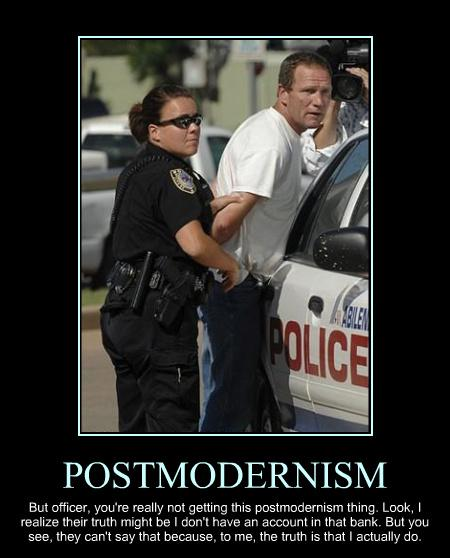
Because everyone has a different cultural heritage, upbringing and personal belief system – views about science, religion art and literature will always clash according to Postmodernism. Postmodernists believe that everyone clings to the metaphorical content (beliefs, legends and morals (even scientific musings) that their culture and upbringing has ‘feed’ them.  It doesn't matter if someone has proof of a belief or aspect of science or art – because if someone else’s view contradicts this proof, then according to Postmodernism – that proof is now null in void. Really, it’s about breaking down the structure of our society and recognizing that everyone has a different view. It is the metaphorical stripping away of right and wrong, and leaving opinions and lack of opinions, impressions and lack of impressions, to determine validity – in fact Postmodernism says that everything is valid and nothing is valid.

I’ll give you an example that may help to explain the basic fundamentals of this belief system (or non belief system – unless you believe that it is an actual belief system, in which case neither one of us is correct. But we can believe both things at the same time, because neither is right or wrong it is simply a view that exists in our brain as a result of our personal environment…unless you believe that it does not exist as result of our personal environment – in which case you are still not wrong…or right – you just are, and you just believe, and because you believe, it can be proved neither right or wrong because it is relevant to you and you have eliminated the very fundamentals of right and wrong by simply believing something…what if you believed that right was wrong? Are you right, or wrong…that you believe ‘right’ is ‘wrong’, because technically if you believe that ‘right’ is ‘wrong’ you aren't wrong – but you aren't right, either…Confused? Welcome to the world of Postmodernism…now let’s get back to that example)

If we were at an ice-cream store, and were buying an ice-cream cone of a certain flavour, we would each have to choose which flavour we wanted. Let’s say I had to choose first. There are three flavours to choose from: Chocolate, Vanilla and Strawberry - but because I was brought up in household that only ate Vanilla – my personal first response is to choose that flavour, and in my opinion it is THE best flavour according to by culture and environment. Ok, it’s your turn next. For arguments sake let’s suppose you choose chocolate because your sister is allergic to strawberries and you prefer the taste of chocolate to vanilla (as does your father – your mother doesn't eat ice-cream because she is probably lactose intolerant) you choose chocolate because of your environment, upbringing and culture too. 

Now Religion says that both of us are wrong, because it is only through Strawberry flavoured ice-cream that we can truly experience true ice-cream gastronomic bliss on our taste buds. Science says that while 67% of the population prefers chocolate over vanilla and strawberry, vanilla is technically the best choice because it is 97% fat free. Postmodernism says that no one is right, or wrong for their personal choice - no one choice is superior to the other because we all have different opinions which have influenced our choices. Postmodernism believes that no opinion should be affected or judged and therefore changed by another - so we can all eat our ice-creams and smile in unity, because really,  we all made the best choice.

Sunday, 26 May 2013

Post Modernism and Christianity 101

Christianity:

Christians believe in one God - Jesus Christ - and that He came down to earth in human form to save the world from eternal suffering by dying on the cross for the sins of humanity. They believe that God created the world and mankind in seven days (commonly known as the creation week). Adam (the first man) and Eve (the first woman) were tempted by the devil (in the form of a serpent) and chose to disobey God. Because of  this, they had to leave the paradise (Garden of Eden) in which they dwelled. Mankind was forever cursed, and pain and suffering entered the world. Thousands of years later, God sent His son to earth to die on the cross for the sin of mankind so that we could have hope in a eternal life with God. 
Christians believe that we are not saved by our works, but by faith and by choosing to accept the gift of Salvation (offered freely to all). Christians believe that God's words can be found in a book called the Bible, which is used for teaching, encouragement of the spirit and spiritual growth - a guideline for life straight from God. Christians consider fellowship with other Christians, prayer, worship, baptism and bible reading as being essential to the Christian faith - just like a plant needs food, water, shelter and light to grow - so to does a Christian need metaphorical 'food' and nutrition and light to grow to be more like Christ Himself. Baptism is considered an important part of Christianity because it is the way in which a person declares publicly that he is a new being in Christ and has chosen to be a follower of Jesus. Now while Christianity is no way to be as a spectacle - it is important for the baptism to be in front of witnesses who can encourage the new convert in their faith and growth as a Christian. 
Christians believe that the church is the active body of Christ in the world. And while there may be countless denominations and varying congregations among those denominations - we are all still His church (despite whether we agree on what is the 'correct way' to worship or not!). The church is not be confused with a literal building where Christians meet usually once or twice a week. Technically this building is called a church, but God made it very clear in the Bible that the church was every Christian in the world - a living, breathing church - actively serving - all making up the 'body'of Christ on earth.


Post Modernism:
Defining post modernism, and refining its extensive definition to a simple black and white explanation, is like…well. Like trying to explain the laws of nuclear physics to a five-year old. So yes, for all you literalists, technically, it’s possible.  But lets be honest – it is also very unlikely that you would actually understand any of the vague, multiple page ‘definitions’ of Post Modernism which I have come across in my research. More importantly however, if I was to simply quote one of these definitions (in all it’s average three page over-intellectualized and unnecessarily elaborate glory) without any explanation – chances are, you wouldn't even finish reading the first sentence – let alone try to actually understand what you are reading (words like ‘boring’ and ‘confusing’ spring to mind).  So, to help you along, and hopefully keep you interested and entertained (alright. To keep you awake) I’m going to take this back to basics – delve into the very ‘bones’, the very essence of what Post Modernism is, as creatively as possible, to give you the best advantage in reading and understanding (and maybe even enjoying!) what my future entries will discuss.


I mean after all, it was Leonardo Da Vinci who said “The noblest pleasure is the joy of understanding.” so in the most colloquial sense – let’s get cracking!


(And don’t worry if you don’t understand it straight away; because as Joe Chung most aptly stated “It always takes an awfully long time to understand unbelievably simple things.” And this friends, is not even a simple thing! So don’t be disheartened – I’m sure you’ll understand it eventually – I’m hoping I will)

So why am I reading this? What's it about?


I will be exploring and discussing the differences and similarities between Christianity and Post Modernism. I will be comparing and contrasting these two belief systems and at the end of my intellectual quest, I will humbly offer my own conclusions and opinions on what I have discovered. I hope that, while you may not agree with my findings,  you will learn a little more about the world around you– or even use this blog as a motivation to start your own research.
Everyone believes in something, even if you believe in ‘nothing’ – you still believe, in that.